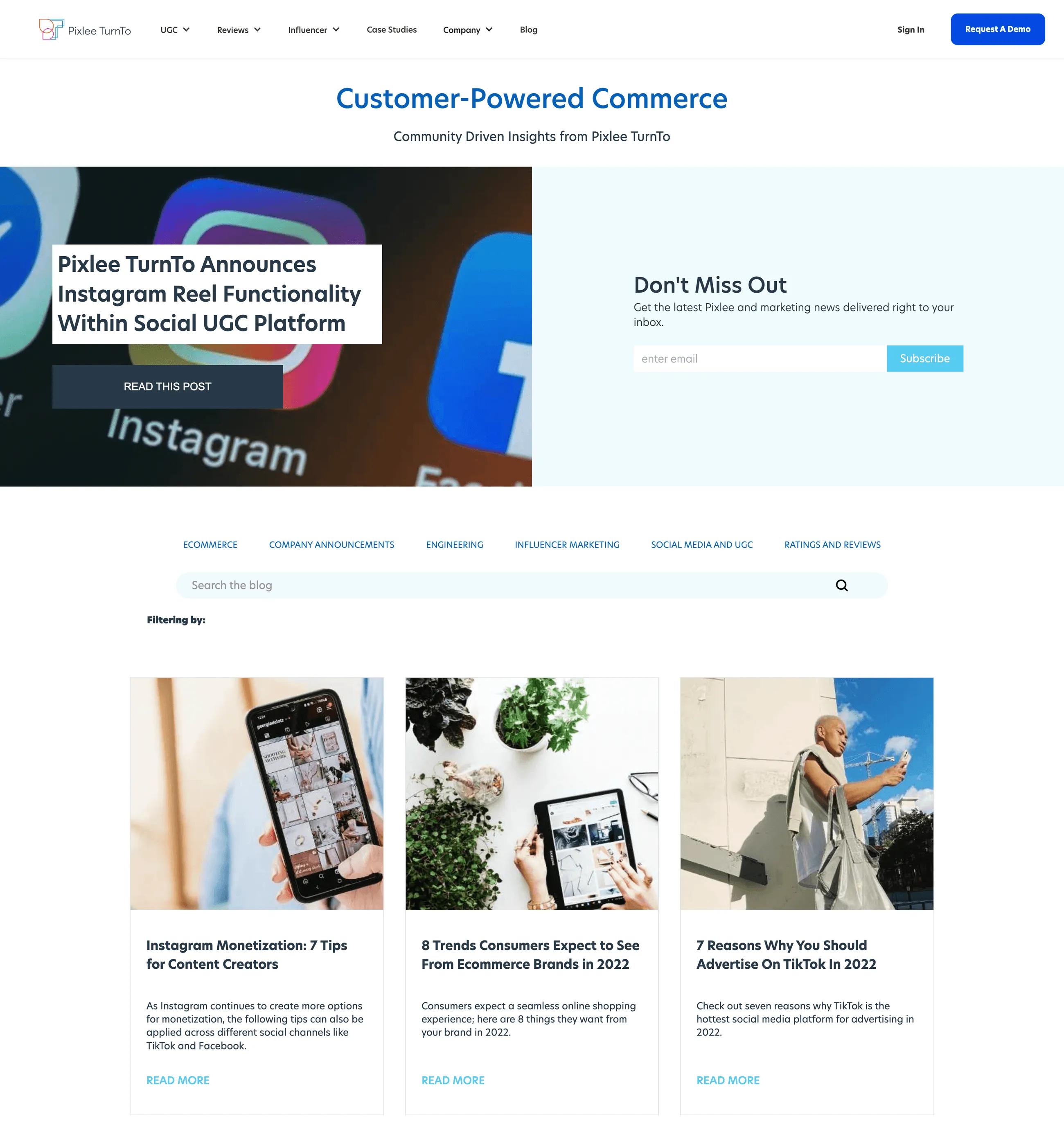
Overview
Pixlee TurnTo helped global brands collect and display social proof — user-generated content, ratings and reviews, and influencer programs — across commerce and marketing stacks. Their marketing engine depended on a large, mature blog: deep archives, category and topic taxonomies, and steady organic traffic.
The blog lived on WordPress. It worked — until it didn't. Performance, editorial friction, and the cost of maintaining a custom stack at that scale pushed the team toward a platform that could ship fast, stay stable, and give marketing direct control. Webflow was the bet.
I led the technical side of the migration: CMS architecture, templates, interactive listing behavior, and the unglamorous work that makes or breaks a project like this — URL parity, metadata, and redirects so search visibility didn't crater mid-move.
After the migration, Pixlee TurnTo was acquired by Emplifi. The blog continues under the Emplifi umbrella as a core resources destination.
The Challenge
This wasn't a brochure site. It was a high-traffic publishing surface with years of equity in URLs, internal links, and rankings. The constraints were technical and political: marketing needed flexibility; SEO needed continuity; readers needed faster pages and clearer ways to browse.
Scale Without a Safety Net
Hundreds of live URLs, each with history in search. A migration that mishandles structure or redirects doesn't just look messy — it quietly bleeds traffic.
WordPress Feature Debt
Filtering, categories, date-driven content, and editorial workflows had accreted over time. Anything built in Webflow had to match real reader behavior, not just look fine in a template.
Marketing Ownership
The goal was operational independence: publish, reorganize, and iterate without opening a ticket for every structural change.
The Core Insight
Treat the migration as a product launch, not a file transfer.
The valuable artifact wasn't a pixel-perfect page — it was continuity: authority preserved, internal links intact, and a CMS that matched how the team actually publishes. Every decision — collection fields, template splits, filter UI, redirect rules — had to be tested against those outcomes.
If SEO and editorial workflow are both first-class requirements, the build order matters: structure and URL strategy before polish; CMS ergonomics before edge-case animations.
Approach
Audit first. Map content types, taxonomies, URL patterns, and high-value landing pages. Identify what must be one-to-one versus what could be consolidated.
Build for the CMS. Webflow's CMS is only as good as the schema — field naming, references, and template boundaries determine whether the team can scale content or fight the system.
Pair engineering with editorial QA. Migrations fail in the gaps: a missing redirect, a truncated meta description, a template that breaks on legacy embeds. Cross-checking with marketing caught those before launch.
Launch with redirect discipline. Systematic 301s from legacy routes to new routes, validated against crawl data and spot checks on high-traffic posts.
What We Built
CMS & templates
Structured the blog in Webflow so posts, categories, and supporting fields mapped cleanly from WordPress. Templates covered listing and detail views with room for the team's ongoing publishing rhythm — not a one-off campaign microsite.
Discovery & filtering
Recreated reader-facing tools to browse content by category and time — the kind of filtering that sounds simple until you account for edge cases, empty states, and performance on long lists.
SEO continuity
Carried forward titles, descriptions, and structured cues where applicable; kept URLs and redirects aligned so the transition read as a platform move, not a new site with amnesia.
Performance & operations
Leaned on Webflow's hosting and asset pipeline so pages loaded faster than the legacy stack, with less operational overhead for the team maintaining it.
Collaboration
I worked tightly with marketing on structure, acceptance testing, and launch sequencing — this project only works when editorial stakeholders trust the CMS. The outcome was a property they could run day to day without developer intervention for routine publishing.
Outcome
The blog relaunched on Webflow with 850+ entries migrated into a coherent CMS, filtering and browse patterns rebuilt for readers, and redirect and metadata work aimed at protecting organic visibility through the cutover. The subsequent Emplifi acquisition shifted branding and ownership, but the migration itself left the team with a faster, more maintainable foundation for content.
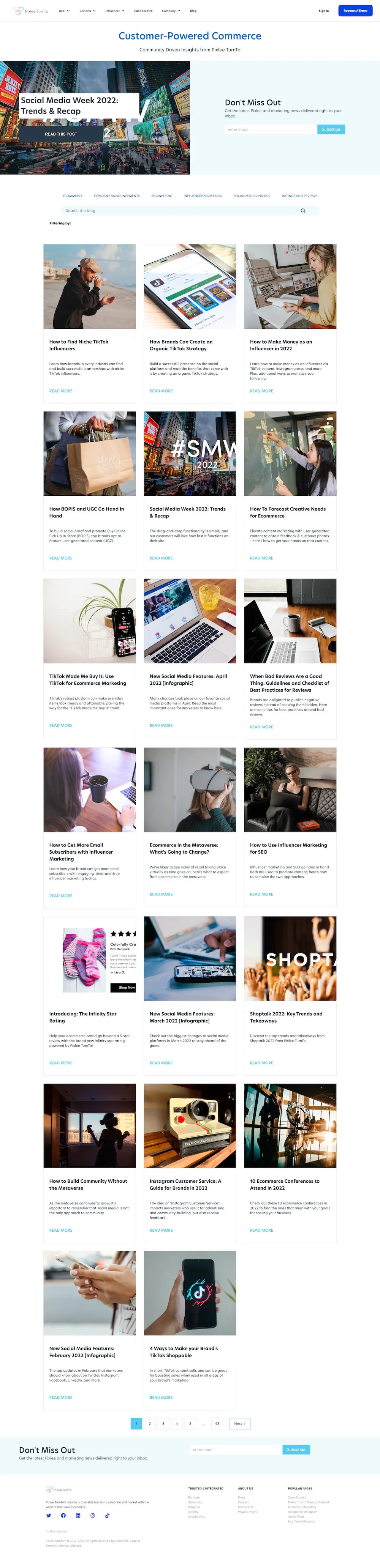
Resources listing — browse and content hierarchy
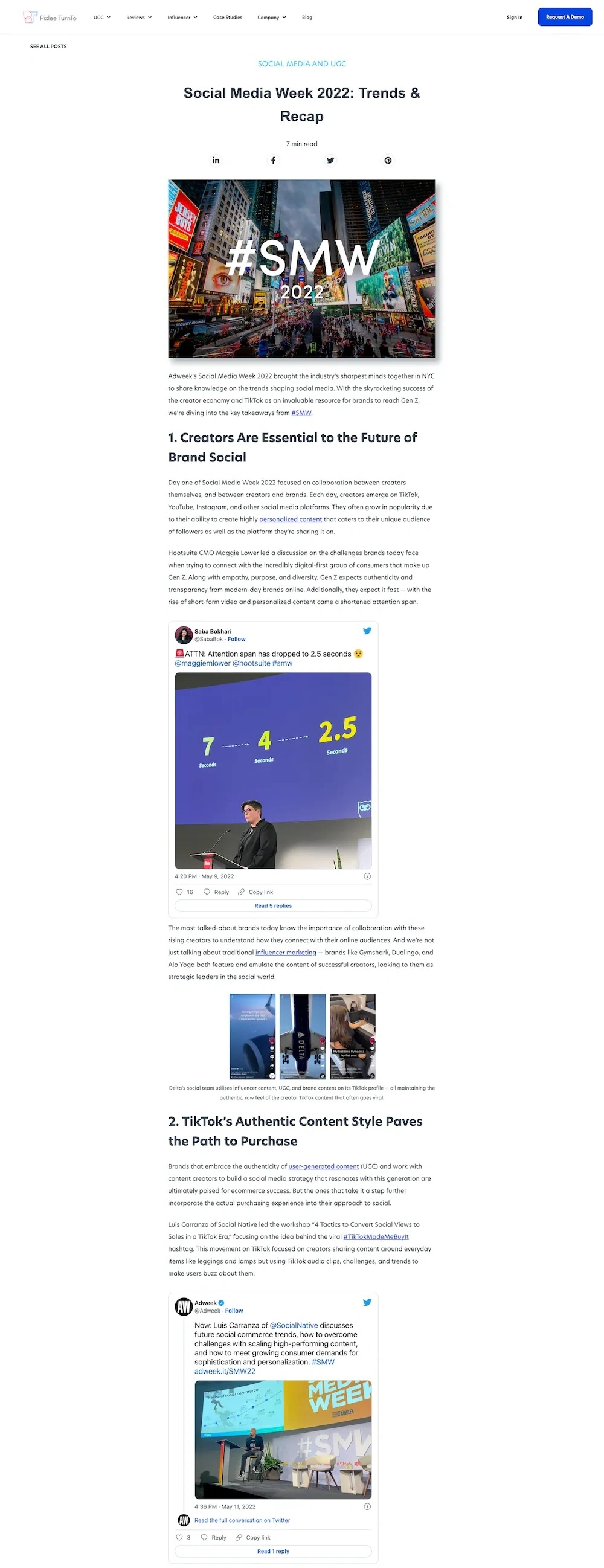
Article template — long-form reading experience
Reflection
Large migrations are a study in risk management. The visible work is the design system and components; the invisible work is what keeps traffic and trust intact. I'm proud of shipping something the marketing team could own — and of treating redirects and metadata with the same seriousness as anything user-facing.
This is the kind of engagement I like: high stakes, clear success metrics, and close partnership with the people who live in the CMS after I hand it off.